

Why brands need to measure campaign effectiveness beyond reach and impressions.
India's Biggest Advertising Season Is Getting Bigger. India's festive season has become one of the most important periods for advertisers. From Onam and Navratri to Diwali and Chhath, brands compete for consumer attention through television, digital platforms, social media, outdoor advertising and retail channels.
In 2026, the scale of this competition is expected to reach a new high.

The scale of investment highlights an important challenge for businesses: when advertising budgets increase and consumers encounter campaigns across multiple platforms, how can brands determine which investments are actually working? Reach, impressions and engagement provide useful indicators of campaign delivery. However, they do not necessarily establish whether advertising has improved brand consideration, influenced purchase decisions or generated incremental sales. The real question is no longer simply how many consumers a campaign reaches, but what changes because the campaign exists.
Where Is Festive Advertising Spending Going?
The composition of advertising expenditure is changing alongside its overall growth.

This shift reflects the growing importance of digital platforms in product discovery, consumer engagement and purchase journeys. Commerce and retail media are also gaining ground.
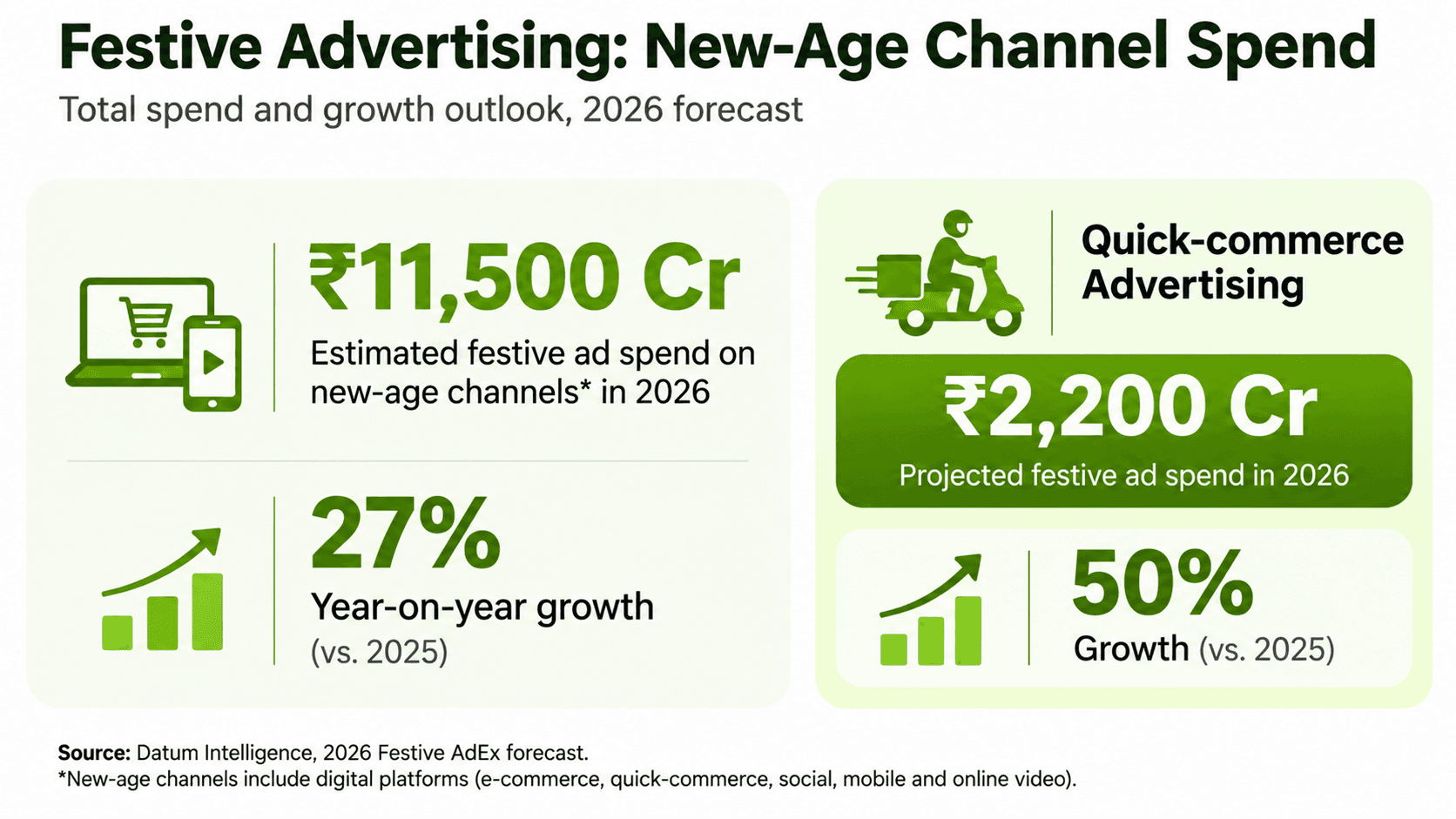
These developments create new opportunities for brands to reach consumers closer to the point of purchase. However, greater digital investment also creates a measurement challenge. Consumers may discover a product through a video, research it through a search engine, compare prices on a marketplace and eventually purchase it in a physical store. If each channel is measured independently, businesses may struggle to understand which interactions genuinely influenced the final decision.
Why Reach and Impressions Are Not Enough
Reach measures the number of people exposed to an advertisement, while impressions measure how many times it was displayed. Both are important for understanding campaign delivery, but neither independently establishes business impact.
Consider a brand that spends ₹5 crore on a festive campaign and generates millions of impressions. The campaign may appear successful when evaluated through visibility alone.
However, three important questions remain:
- Did more consumers become aware of the brand?
- Did the campaign improve consideration and purchase intent?
- Did it generate additional sales that would not otherwise have occurred?
Without answering these questions, a business risks confusing advertising exposure with advertising effectiveness. A campaign can achieve high engagement without influencing purchases. Conversely, a campaign with lower reach may generate stronger results if it reaches the right audience with a relevant message.
Effective measurement connects advertising activity to consumer response and commercial outcomes.
What Should Brands Measure Instead?
A more comprehensive measurement framework should examine four dimensions.
Brand impact: Assess changes in brand awareness, recall, consideration and perceptions before and after a campaign. Brand-lift studies can help determine whether advertising improved these measures among exposed audiences relative to an appropriate comparison group.
Consumer response: Examine message relevance, creative effectiveness, purchase intent and the reasons consumers respond positively or negatively. This helps identify whether the campaign is communicating the right message to the intended audience.
Sales and conversion: Track website visits, enquiries, store visits where measurable, conversions and sales. Where possible, distinguish incremental outcomes from purchases that would have occurred without the campaign.
Commercial returns: Evaluate campaign costs against incremental revenue, contribution margin and profitability. Return on advertising spend (ROAS) is useful, but revenue alone does not account for product margins, discounts, fulfilment costs or other expenses.
Together, these measures provide a more balanced understanding of whether a campaign delivered visibility, changed consumer behaviour and created business value.
How Can Brands Measure Campaign Effectiveness More Reliably?
Measurement should begin before the campaign launches, rather than after the budget has been spent.
First, brands should establish clear objectives. A campaign designed to build awareness requires different success measures from one intended to drive immediate festive purchases.
Second, businesses should establish a baseline using historical performance, pre-campaign consumer research or other relevant benchmarks.
Third, they should monitor performance across channels using consistent definitions. This reduces the risk of comparing metrics that measure different outcomes.
Finally, brands should assess incrementality wherever feasible. Geographic holdouts, controlled experiments and exposed-versus-control audience studies can help estimate whether the campaign caused an improvement rather than merely coinciding with one. For example, if sales increase during Diwali, the increase cannot automatically be attributed to advertising. Discounts, seasonal demand, distribution expansion and competitor activity may also contribute.
A stronger evaluation combines sales data with campaign exposure, consumer research and an appropriate comparison method.
Electroyuva's Perspective: Turning Advertising Data into Business Insight
At Electroyuva, we believe advertising effectiveness should be evaluated through a combination of consumer understanding, communication research and business outcomes. Campaign dashboards can show what happened. Research helps businesses understand why it happened, who responded and what should change next time. Our approach focuses on four questions:
- Did the campaign reach the right audience? Understand audience relevance, awareness and exposure quality.
- Did the message influence consumer perceptions? Assess recall, message comprehension, brand associations and purchase consideration.
- What influenced consumer response? Investigate creative appeal, product relevance, price perceptions and competing messages.
- What should the brand do next? Translate the findings into recommendations on communication, channel priorities, audience targeting and future campaign investment.
Combining quantitative surveys, qualitative interviews, campaign data and secondary research can help businesses move beyond reporting metrics towards actionable insights.
The objective is not simply to measure advertising performance. It is to help brands make better decisions about where to invest, which messages to strengthen and how to improve future campaigns.
Measure What Advertising Changes
India's festive advertising market is expected to reach ₹60,000–62,000 crore in 2026, making it a critical period for brands competing for consumer attention. At the same time, the growth of digital, commerce and retail media is creating more opportunities to connect advertising with consumer behaviour and sales. Yet larger budgets and greater visibility do not automatically guarantee better outcomes.
Brands need to understand whether campaigns improve consumer perceptions, influence purchase decisions and generate incremental commercial value.The most effective advertising strategy is not necessarily the one that reaches the most people. It is the one that reaches the right people, changes the right perceptions and delivers measurable business impact.
Electroyuva helps businesses turn consumer and communication research into actionable insights that strengthen marketing decisions and improve campaign effectiveness.
Electroyuva | Consumer Intelligence. Market Understanding. Business Growth.
Sources:
Datum Intelligence, 2026 Festive AdEx. Report and forecast.
ETBrandEquity, Festive AdEx Rises Up to 15% as Quick Commerce, Creators Gain Ground, October 6, 2026. Read the report.
Data note: All 2026 advertising expenditure figures are forecasts, not final audited spending totals. Campaign measurement recommendations represent general research and evaluation practices, not findings directly established by the advertising expenditure forecast.